
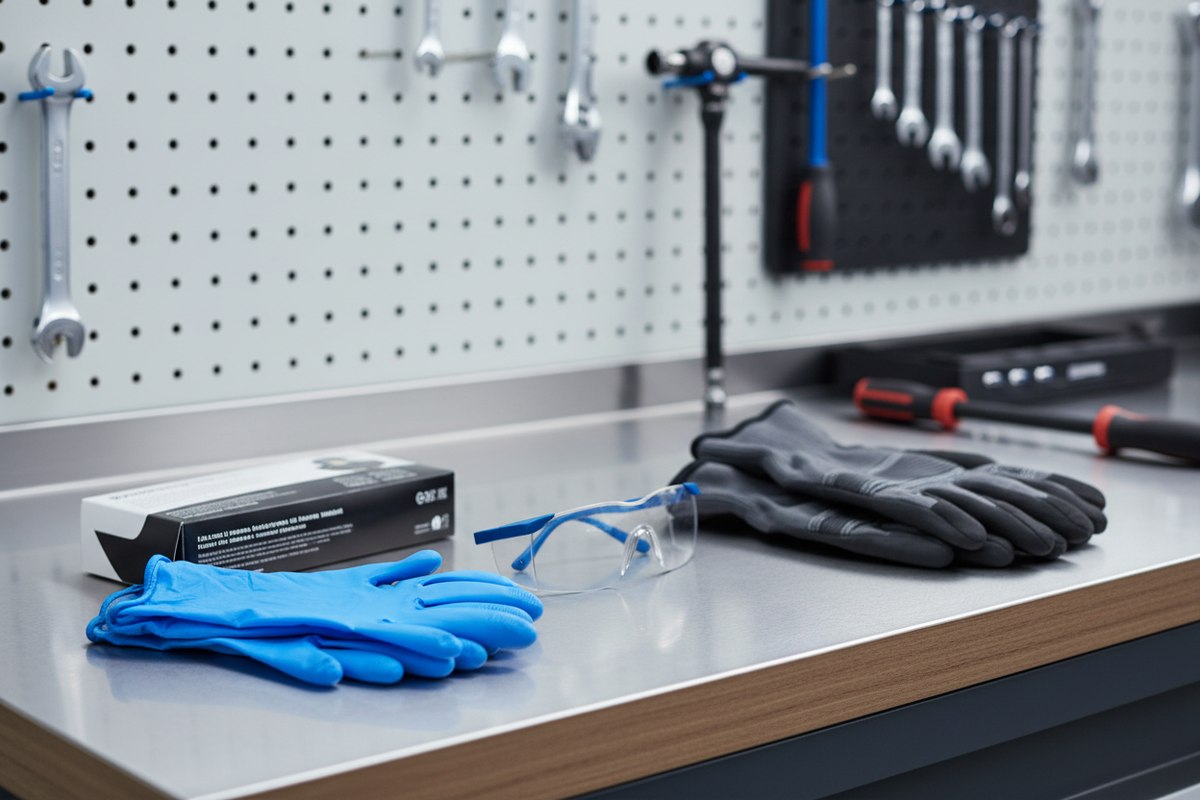
How to Choose the Right Gloves for Automotive Service Technicians
Automotive service technicians work with oil, grease, solvents, coolants, brake fluids, fuels, sharp components, hot parts, tools, and other hazards that can put their hands at risk.
That makes choosing the right automotive service gloves more important than simply buying the cheapest disposable glove available.
The right glove needs to provide an appropriate combination of chemical protection, durability, grip, dexterity, tactile sensitivity, comfort, and fit for the job being performed. A technician changing oil may need a different glove from someone handling sharp parts, cleaning components with solvents, or performing electrical service.
OSHA's hand-protection standard requires employers to select appropriate protection based on the performance characteristics of the glove relative to the task, conditions, duration of use, and identified hazards.
This guide explains how automotive shops can evaluate glove materials and features and build a practical glove inventory for their service technicians.
Why Glove Selection Matters in Automotive Service
Technicians' hands are exposed to a wide variety of hazards throughout a typical workday. These may include petroleum products, lubricants, cleaning chemicals, sharp metal edges, abrasive surfaces, hot components, and contaminated parts.
Gloves can help reduce exposure, but only when the glove is appropriate for the hazard.
OSHA notes that no glove material protects against every potential hand hazard. Employers should therefore evaluate the specific hazards and select hand protection accordingly.
The wrong glove can create problems such as:
- Chemical permeation or breakthrough
- Tears and punctures
- Reduced grip
- Loss of dexterity
- Hand fatigue
- Skin exposure
- Reduced technician productivity
For automotive shops, glove selection should be viewed as a task-specific PPE decision rather than a one-size-fits-all purchasing decision.
1. Start With the Automotive Task
The first question when choosing a glove should be: What will the technician be doing while wearing it?
Different automotive tasks create different combinations of chemical, mechanical, thermal, and ergonomic hazards.
For example:
- Oil changes: require protection from oils, grease, and contaminated components.
- Parts cleaning: may involve solvents or specialized cleaning chemicals.
- Brake service: can involve dust, grime, sharp components, and chemical products.
- Engine repair: may involve oils, sharp edges, abrasion, and hot components.
- Detailing: can involve cleaning chemicals and prolonged wet exposure.
- Parts handling: may create cut, puncture, and abrasion hazards.
- Electrical service: can require specialized electrical PPE when an electrical shock hazard exists.
OSHA specifically recommends considering the nature of the hazard, operation, exposure duration, frequency, and physical stresses when selecting gloves.
2. Nitrile Gloves: A Popular Choice for Automotive Technicians
Nitrile gloves are widely used for automotive maintenance because they can provide a useful combination of dexterity, tactile sensitivity, abrasion resistance, and protection from many oils and greases.
OSHA's PPE guidance identifies nitrile as a glove material used for chemical protection and notes its resistance to abrasion, puncturing, snagging, and tearing in appropriate applications.
For many routine automotive tasks, disposable nitrile gloves are a practical choice because technicians can replace contaminated gloves rather than carrying contamination from one task to another.
BSC Supply offers the BLUZEN Disposable Nitrile Gloves. The 3 mil gloves are powder-free, blue, and designed for durability, comfort, and routine hand protection.
Nitrile gloves can be useful for:
- Oil changes
- Routine vehicle maintenance
- Handling greasy components
- General service-bay work
- Fluid checks
- Light-duty cleaning
However, technicians should not assume that a disposable nitrile glove is suitable for every automotive chemical. Chemical resistance varies by glove formulation, thickness, chemical, concentration, temperature, and exposure duration.
3. Choose the Right Glove Thickness
Glove thickness can affect durability, tactile sensitivity, dexterity, and comfort.
Thinner disposable gloves can provide excellent tactile feedback and dexterity, making them useful for tasks where technicians need to feel small components or manipulate tools.
Thicker gloves may provide additional durability and resistance to tearing or puncturing, although increased thickness can affect dexterity.
For example, BSC Supply's Kimtech Purple Nitrile-Xtra Exam Gloves are listed at 5.9 mil thickness and feature textured fingertips, a 12-inch glove length, and latex-free nitrile construction.
The right thickness depends on the job—not simply on choosing the thickest glove available.
4. Consider Chemical Resistance
Automotive shops routinely use or encounter chemicals, including solvents, cleaners, fuels, lubricants, and other fluids.
One of the most important glove-selection mistakes is assuming that a glove labeled “chemical resistant” is resistant to every chemical.
OSHA recommends evaluating the specific chemical, concentration, duration and type of contact, temperature, and physical stresses involved when selecting chemical-resistant gloves.
For chemical-intensive tasks, technicians and safety personnel should consult the chemical's SDS and the glove manufacturer's chemical-resistance data.
Important factors include:
- Chemical identity
- Chemical concentration
- Contact time
- Temperature
- Splash versus immersion
- Glove material
- Glove thickness
- Breakthrough time
When a task involves prolonged chemical exposure, a specialized chemical-resistant glove may be more appropriate than a thin disposable examination-style glove.
5. Disposable vs. Reusable Automotive Gloves
Automotive shops commonly use both disposable and reusable gloves.
Disposable gloves
Disposable nitrile gloves are convenient for jobs where contamination is frequent. A technician can remove a contaminated pair and replace it with a clean pair before moving to another task.
Advantages can include:
- Fast replacement
- Good tactile sensitivity
- Convenient sizing
- Reduced cross-contamination between tasks
- Useful protection for routine fluid handling
Reusable gloves
Reusable gloves can make sense for tasks requiring greater durability, longer cuffs, heavier material, or extended protection from particular chemicals or mechanical hazards.
They may be appropriate for certain cleaning, parts-handling, maintenance, or chemical-handling applications.
Reusable gloves should be inspected and maintained according to manufacturer instructions. OSHA emphasizes that PPE should be maintained in a clean and reliable condition.
6. Don't Ignore Cut and Puncture Hazards
Automotive technicians regularly handle metal components, brackets, clips, fasteners, tools, and parts with sharp edges.
A disposable nitrile glove may provide some resistance to minor tearing, but it should not automatically be considered cut-resistant PPE.
When a task presents a significant cut hazard, the shop should consider a glove specifically tested and rated for the applicable cut hazard.
OSHA identifies cuts, lacerations, abrasions, and punctures among the hazards that should be considered when selecting hand protection.
Consider specialized cut-resistant gloves for tasks such as:
- Handling sharp metal components
- Sheet-metal work
- Parts handling
- Fabrication
- Working around sharp edges
- Other tasks identified through the facility's hazard assessment
7. Grip Is Just as Important as Protection
A glove can provide protection but still be a poor choice if it causes tools or components to slip.
Automotive technicians often work with oily, wet, dirty, or greasy components. Gloves with textured fingertips or textured palms may help improve grip and handling.
BSC Supply's Kimtech Purple Nitrile-Xtra Gloves, for example, feature textured fingertips intended to improve grip and dexterity.
When comparing gloves, consider whether technicians need:
- Dry grip
- Wet grip
- Oily grip
- Fine fingertip control
- Full-hand grip
Grip requirements should be evaluated alongside chemical and mechanical protection rather than separately.
8. Fit and Dexterity Matter
Automotive technicians frequently work in tight spaces and manipulate small components. An oversized glove can interfere with precision, while an undersized glove can create discomfort and increase the likelihood of tearing.
OSHA's PPE guidance emphasizes proper sizing and fit. Gloves should allow employees to perform the task without unnecessarily restricting movement.
A good automotive glove should:
- Fit securely around the fingers
- Allow normal hand movement
- Permit appropriate tactile feedback
- Remain secure during tool use
- Not create excessive bunching
- Be comfortable enough for the expected duration of use
Shops should stock the sizes technicians actually need rather than assuming one size will work for everyone.
9. Latex vs. Nitrile for Automotive Service
Latex gloves can offer flexibility and good tactile characteristics, but nitrile is often a practical choice for automotive environments because of its resistance to many oils and greases and because it avoids exposure to natural rubber latex proteins.
OSHA notes that natural rubber/latex can have useful physical properties but performs poorly against oils, greases, and some organic substances.
For general automotive service, a powder-free nitrile glove is therefore often a more appropriate starting point than a latex glove.
However, glove selection should still be based on the actual task and chemical involved rather than on material name alone.
10. Vinyl Gloves: Where Do They Fit?
Vinyl gloves can be useful for certain low-risk, short-duration tasks where chemical resistance and mechanical durability are not the primary concerns.
BSC Supply offers OmniShield Vinyl Powder Free Clear Multi-Purpose Gloves, which are made from polyvinyl chloride and designed to provide comfort and tactile sensitivity.
For demanding automotive service work involving oils, grease, solvents, sharp parts, or significant mechanical stress, facilities should carefully evaluate whether vinyl provides the required performance before selecting it as the primary technician glove.
11. Consider Long-Cuff Gloves for Certain Tasks
Some automotive tasks create exposure beyond the hand itself. When liquids may run down the wrist or forearm, a longer glove cuff can provide additional coverage.
For example, BSC Supply's Kimtech Purple Nitrile-Xtra is listed with a 12-inch glove length.
Longer gloves may be particularly useful for tasks involving splashing, messy fluid handling, or situations where additional wrist and forearm coverage is appropriate.
However, glove length should be selected based on the actual exposure—not simply because a longer glove is always better.
12. Think About Heat and Hot Components
Automotive technicians can encounter hot engines, exhaust components, brakes, fluids, and other equipment.
A disposable nitrile glove should not be treated as heat-resistant PPE unless the manufacturer specifically indicates that it is suitable for the temperature and application.
Where a task presents a significant thermal hazard, the shop should select gloves specifically designed and tested for the expected heat exposure.
OSHA identifies thermal burns and harmful temperature extremes among the hazards that require consideration when selecting hand protection.
13. Electrical Service Requires Specialized Protection
Modern vehicles contain increasingly sophisticated electrical and high-voltage systems. Technicians working on electrical systems should not assume that ordinary nitrile, latex, vinyl, or general-purpose work gloves provide electrical protection.
Where an electrical shock hazard exists, appropriate electrically insulating PPE must be selected based on the applicable requirements, task, voltage, and manufacturer's specifications.
OSHA distinguishes electrical protective equipment from ordinary hand protection and requires appropriate electrical protection where workers are exposed to electrical shock hazards.
For high-voltage vehicle systems, follow the vehicle manufacturer's service procedures and the shop's electrical-safety program.
14. A Practical Automotive Glove Inventory
Instead of trying to find one glove that works for every technician and every task, automotive shops can maintain a small selection of gloves for different applications.
| Glove Type | Potential Automotive Uses | Key Considerations |
|---|---|---|
| Disposable nitrile | Oil changes, routine service, fluid handling | Dexterity, tactile sensitivity, oils/grease resistance |
| Thicker nitrile | Messier or more demanding routine tasks | Durability versus dexterity |
| Long-cuff nitrile | Splash-prone or messy tasks | Additional wrist/forearm coverage |
| Chemical-resistant gloves | Specific chemical handling | Select based on chemical-resistance data |
| Cut-resistant gloves | Sharp-part handling | Use appropriate cut-resistance rating |
| Heat-resistant gloves | Hot components and high-temperature work | Must match expected temperature |
| Electrical insulating gloves | Applicable electrical/high-voltage work | Specialized PPE; follow applicable requirements |
| Vinyl gloves | Low-risk, short-duration tasks | Limited suitability for demanding mechanical/chemical work |
15. Inspect Gloves Before and During Use
Choosing the right glove is only part of effective hand protection. Technicians should also know when gloves need to be replaced.
Disposable gloves should be replaced when they become damaged, contaminated, or otherwise unsuitable for continued use.
Reusable gloves should be inspected for:
- Cracks
- Holes
- Tears
- Thinning
- Discoloration
- Loss of flexibility
- Signs of chemical degradation
OSHA recommends training workers to recognize signs of glove wear and ensuring PPE is properly maintained.
16. Build Your Glove Program Around Technician Tasks
The most effective glove program is not necessarily the one with the largest number of glove styles. It is the one that matches the shop's actual work.
Start by identifying the most common service tasks and the hazards associated with each. Then select glove types that provide appropriate protection without unnecessarily compromising dexterity or productivity.
For many automotive service departments, a practical starting inventory might include:
- Disposable nitrile gloves in multiple sizes
- A heavier-duty nitrile option
- Long-cuff gloves for appropriate tasks
- Cut-resistant gloves
- Chemical-resistant gloves for designated chemical applications
- Heat-resistant gloves for appropriate hot-work tasks
- Specialized electrical PPE where required
This approach gives technicians options while keeping purchasing and inventory management manageable.
How to Choose the Right Automotive Gloves: Quick Checklist
- Identify the hazard: Chemical, mechanical, thermal, electrical, or a combination.
- Identify the task: Oil change, parts handling, cleaning, repair, electrical work, etc.
- Check chemical compatibility: Use manufacturer data and the applicable SDS.
- Choose the material: Nitrile, vinyl, neoprene, butyl, leather, or another appropriate material.
- Choose the thickness: Balance durability and dexterity.
- Evaluate grip: Consider oily, wet, and dry working conditions.
- Choose the correct size: Proper fit supports comfort and control.
- Consider cuff length: Select additional coverage when the task warrants it.
- Check required performance ratings: Particularly for cut, heat, or electrical hazards.
- Train technicians: Employees should understand glove limitations, replacement, and safe removal.
Shop Automotive Service Gloves at BSC Supply
Choosing the right gloves starts with understanding what your technicians actually do. Once the hazards and tasks are identified, BSC Supply makes it easier to build an automotive glove inventory around those requirements.
BSC Supply's Automotive collection is designed to support automotive departments, while its Gloves collection provides access to a broad range of hand-protection products.
For everyday automotive service, review the BLUZEN Disposable Nitrile Gloves. For a heavier 5.9 mil nitrile option with textured fingertips and a longer 12-inch length, review Kimtech Purple Nitrile-Xtra Gloves. For latex-free nitrile exam gloves with a textured grip, BSC Supply also offers IMCO Brand Nitrile Exam Gloves.
For lower-risk applications where vinyl is appropriate, review OmniShield Vinyl Powder Free Clear Multi-Purpose Gloves.
Give your technicians the right hand protection for the job—not just the cheapest glove in the supply room.
Shop Automotive Gloves at BSC Supply →
Frequently Asked Questions
What are the best gloves for automotive service technicians?
For many routine automotive service tasks, disposable nitrile gloves are a practical choice because they can provide dexterity, tactile sensitivity, and resistance to many oils and greases. However, the appropriate glove depends on the specific task and hazard.
Are nitrile gloves good for automotive work?
Nitrile gloves can be well suited to many automotive tasks involving oils, grease, and routine maintenance. However, chemical compatibility should be verified for specific solvents, cleaners, fuels, and other chemicals before use.
What thickness nitrile glove is best for mechanics?
There is no single ideal thickness. Thinner gloves generally prioritize tactile sensitivity and dexterity, while thicker gloves can provide greater durability. The best thickness depends on the technician's task and the hazards involved.
Are latex gloves good for automotive technicians?
Latex can provide flexibility and tactile sensitivity, but it is not automatically the best choice for automotive work. Latex has limitations with some oils, greases, and organic chemicals, and natural rubber latex can also present sensitization concerns. Nitrile is often a practical alternative for general automotive service.
Are vinyl gloves suitable for automotive work?
Vinyl gloves may be suitable for certain low-risk, short-duration tasks, but they should be evaluated carefully for automotive applications involving oils, chemicals, sharp components, or significant mechanical stress.
Do mechanics need cut-resistant gloves?
Cut-resistant gloves may be appropriate for tasks involving sharp metal components, sheet metal, or other significant cut hazards. A standard disposable nitrile glove should not be treated as cut-resistant PPE unless its manufacturer specifically provides the applicable performance information.
What gloves should technicians use around automotive chemicals?
The correct glove depends on the specific chemical, concentration, temperature, exposure duration, and type of contact. Technicians should consult the chemical's SDS and the glove manufacturer's chemical-resistance information rather than relying solely on the glove material name.
Do nitrile gloves protect against electrical shock?
Ordinary nitrile gloves should not be considered electrical insulating PPE. When an electrical shock hazard exists, technicians need appropriately rated electrical protective equipment selected for the task and voltage.